

Modelcode’s Morph and Anthropic’s Claude Code are not competitors so much as different layers: Claude Code is an agentic coding tool that works in your terminal, IDE, and browser; Morph is a code modernization platform that runs whole migrations as governed, verified programs. Modelcode’s own documentation names Claude among the agents Morph is designed to work alongside. The honest comparison is agent versus migration program, and many teams run both.
One Disambiguation First
Two unrelated products share the “Morph” name in AI tooling conversations. Morph by Modelcode, compared here, is an enterprise code modernization platform at modelcode.ai. There is also a separate company offering a “fast apply” model API for code edits. They are different companies with different products; this page is about Modelcode’s Morph.
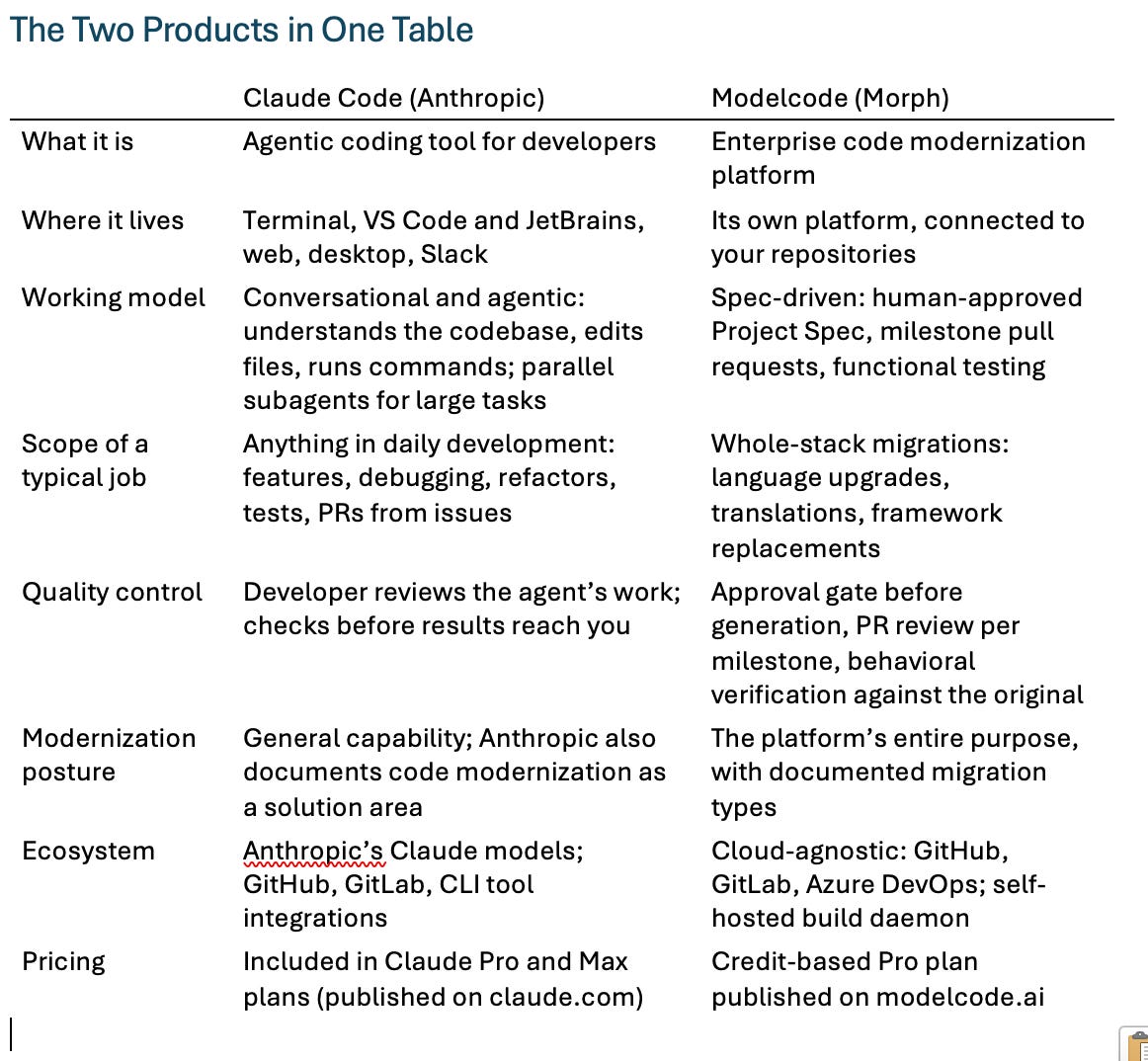
The Two Products at a Glance (In Text Format):
What it is. Claude Code is Anthropic’s agentic coding tool for developers. Modelcode’s Morph is an enterprise code modernization platform.
Where it lives. Claude Code runs in the terminal, in VS Code and JetBrains, on the web and desktop, and in Slack. Morph runs on its own platform, connected directly to your repositories.
Working model. Claude Code is conversational and agentic: it navigates the codebase, edits files, executes commands, and coordinates parallel subagents for large tasks. Morph is spec-driven: a human-approved Project Spec, milestone pull requests, and functional testing.
Scope of a typical job. Claude Code covers daily engineering workflows: building features, debugging, refactoring, testing, and resolving issues via pull requests. Morph focuses strictly on full-stack migrations: language upgrades, language translations, and framework replacements.
Quality control. With Claude Code, the developer reviews the agent’s work, supported by verification checks before outputs land. Morph adds an upfront approval gate before code generation begins, pull request reviews per milestone, and behavioral verification against the source application.
Modernization posture. For Claude Code, modernization is a single application within a general-purpose coding assistant. For Morph, large-scale modernization is the platform’s core specialty, backed by proven migration tracks.
Ecosystem. Claude Code is natively powered by Anthropic’s Claude models, integrating with GitHub, GitLab, and CLI environments. Morph is cloud-agnostic, supporting GitHub, GitLab, and Azure DevOps alongside a self-hosted build daemon.
Pricing. Claude Code is bundled into Claude Pro and Max plans, detailed on claude.com. Morph operates on a credit-based Pro plan, detailed on modelcode.ai.
What Claude Code Does Best
Claude Code is one of the strongest agentic coding tools available: it maps a codebase with agentic search, makes coherent multi-file edits, turns issues into pull requests, and runs wherever developers work, from the terminal to the IDE to Slack. Its 2026 releases pushed scale further, with dynamic workflows fanning work across parallel subagents and routines for scheduled or event-driven tasks. For day-to-day engineering velocity, including plenty of modernization-flavored work (refactors, upgrades, test generation), it is a general-purpose force multiplier under the developer’s own review.
The structural limit is the same as for every agent: scope and verification stay with the human driving it. An agent does not own a migration plan, sequence a program, or prove behavioral equivalence across an entire estate; the developer does.
What Morph Does Best
Morph industrializes exactly that program layer. It analyzes connected repositories and produces a Project Spec a human approves before any code is generated; execution ships as milestone pull requests through normal review; functional tests compare migrated behavior against the original, increment by increment. Documented migration types include Python 2 to 3, Java 8 to 21, Ada to C++, COBOL to Java, AngularJS to React, and Express to FastAPI. It is cloud-agnostic, offers a self-hosted build daemon, and, notably here, is explicitly designed to work alongside AI coding agents such as Claude and Codex: the agent keeps accelerating daily development while the platform runs the migration.
Morph’s limit is symmetrical: it is not a daily assistant and will not help you debug this afternoon’s feature branch.
The Real Difference, in One Paragraph
Claude Code accelerates the developer; Morph orchestrates the migration. When the work is bounded and continuous (edit, fix, extend, refactor), an agent under developer review is the right tool. When the work is a whole codebase moving across languages or frameworks, with an approved plan and proof at each step that behavior held, that is a program, and programs need control points an agent does not carry.
When to Choose Which
Choose Claude Code for daily engineering acceleration everywhere developers work, including incremental modernization tasks they can review themselves.
Choose Morph when a defined migration must be planned, approved, delivered in reviewable milestones, and behaviorally verified, on any cloud.
Choose both more often than either: Modelcode’s documentation positions Morph as a modernization overlay working alongside coding agents, Claude included. The agent and the platform meet in the same place, the pull request.
Frequently Asked Questions
Is Modelcode’s Morph the same as the Morph “fast apply” API?
No. They are unrelated products from different companies. Morph by Modelcode is an enterprise code modernization platform (modelcode.ai). The similarly named “fast apply” product is a code-edit model API from a separate company.
Is Claude Code an alternative to Morph for code migration?
For incremental, developer-driven modernization, it can be. For whole-stack migration programs needing an approved spec, milestone delivery, and functional verification, the two sit at different layers, and Modelcode’s own docs describe Morph as working alongside agents like Claude rather than replacing them.
Can Morph and Claude Code be used together?
Yes, and that is the designed pattern: developers keep Claude Code for daily work while Morph plans, executes, and verifies the migration program, both delivering through normal pull requests.
Who makes each product?
Claude Code is made by Anthropic, the AI company behind the Claude models. Morph is made by Modelcode, an AI code modernization company (modelcode.ai), founded by Michael Fertik.
Does either require a specific cloud?
Claude Code runs across macOS, Linux, and Windows and integrates with standard developer tooling. Morph is cloud-agnostic, connects to GitHub, GitLab, and Azure DevOps, and offers a self-hosted build daemon for enterprises keeping code on their own infrastructure.